
Customer Focus: Setting a Clear Strategic Direction for Healthcare

The 4-Core Leadership Program — designed by Nancy Riegel — is a practical leadership framework built on integrity and trust, customer focus, adaptability in complexity, and disciplined execution. This program reflects my work supporting leaders and organizations in healthcare, manufacturing, and complex systems to build strong culture, accountability, and sustainable performance.
Why Healthcare Economics and Leadership Must Start With Employees
Several years ago, I supported a Fortune 500 company in setting its strategic direction. One of their four core pillars was customer focus, and it was non-negotiable. It was the price of entry. Employees at every level were expected to demonstrate behaviours aligned with strong customer focus. It showed up in attitude, in how people treated one another, and in whether those around them felt valued and well served.
The result was a strong culture where both employees and customers mattered. And the stories people told—how they spoke about serving others and what truly mattered to them—drew us together. When people shared their hearts that way, it was genuinely life-changing.
So how can healthcare reframe its approach to customer focus—positively and intentionally?
When viewed through the lens of healthcare economics, one connection is consistently clear: when employees are treated with dignity and respect, the benefits extend across the entire organization. Engagement improves. Retention improves. Costs lessen. Employees who feel valued are more likely to take ownership, look for efficiencies, and protect resources. They also stay—and the cost of rehiring in healthcare is enormous.
But this does not happen by accident. It must be built—intentionally and with purpose.
Leadership Sets the Standard
Strong customer focus begins at the top. Leaders must set the direction, live the values, and model the behaviours they expect others to follow.
Customer focus also requires practical action:
Giving employees the tools they need to thrive
Providing appropriate training
Allowing flexibility when family responsibilities arise
Supporting time off when needed
Recognizing exceptional, and/or steady performance when it is observed
This leadership responsibility is reinforced by Deloitte’s research on healthcare workforce challenges. Deloitte reports that fewer than half of frontline clinicians trust their organization’s leadership to do what is right for patients, and only about 23% trust leaders to do what is right for workers. Deloitte’s research also shows that trust—both in decisions made for patients and for employees—is closely linked to lower burnout and stronger organizational performance. Rebuilding that trust requires leaders to listen, support, and invest in their people’s well-being and career development.
Source:
Deloitte Insights – “Addressing health care’s talent emergency”
https://www.deloitte.com/us/en/insights/industry/health-care/healthcare-workforce-shortage-solutions.html
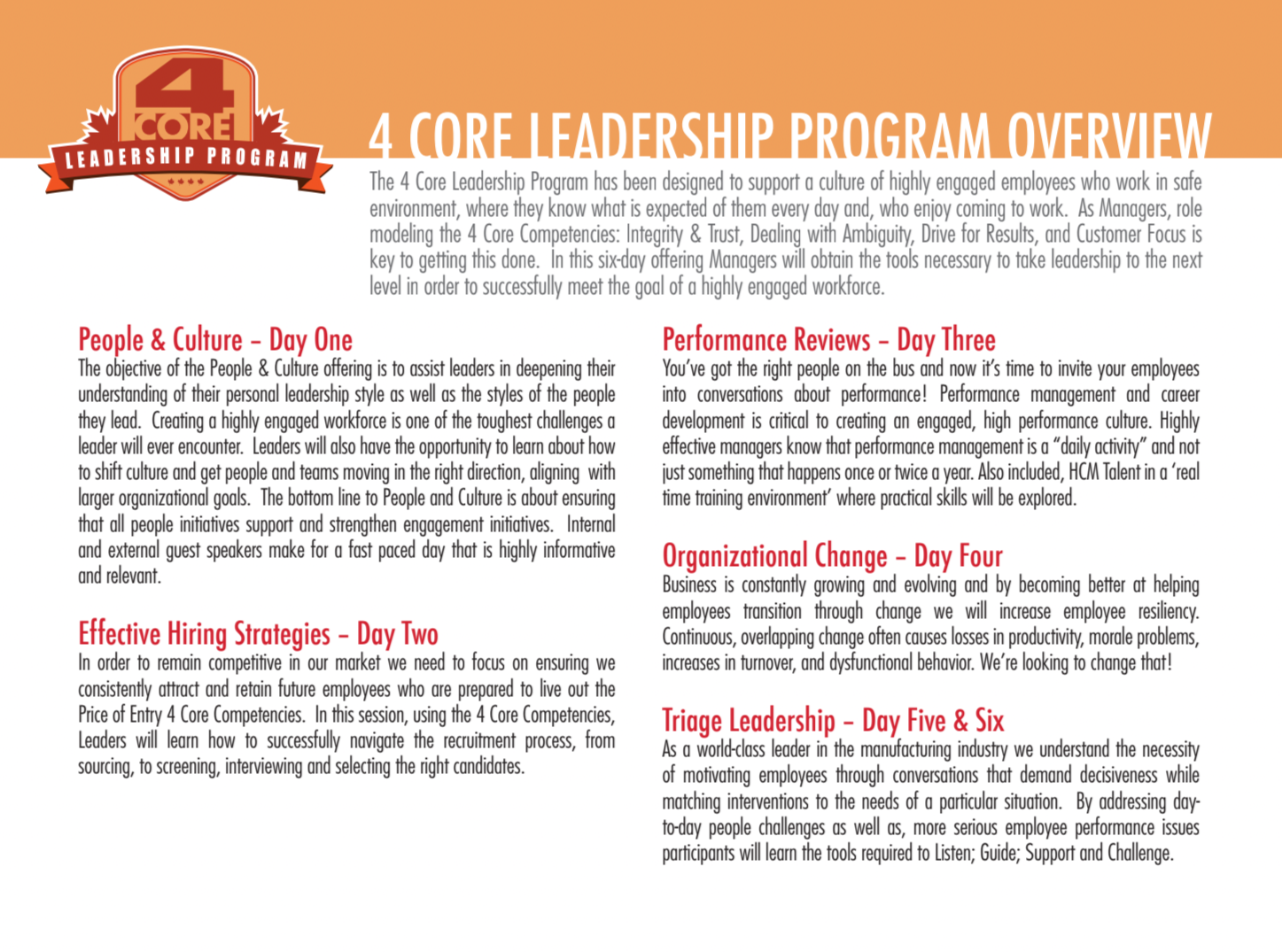
High-level overview of a leadership program designed for complex organizations, focused on practical leadership behaviours that produced measurable improvements in culture and workforce stability.
Customer Focus Begins With Employees
When customer focus is treated only as a patient-facing concept, healthcare organizations miss the most powerful lever available to them.
Customer focus, at its core, is a leadership discipline. Organizations that understand their first customer is their employee create the conditions for trust, accountability, and consistent performance. When leaders take care of their people, employees are far more likely to take care of patients.
When organizational values are clearly defined, consistently modelled by leadership, and experienced in daily practice, employees are far more likely to remain engaged and committed to the organization.
This is supported by research published in Mayo Clinic Proceedings, which examined organizational culture, employee engagement, and wellbeing in healthcare settings. The study found that when staff perceive an organization’s values as authentic and consistently acted upon, levels of engagement and wellbeing are significantly higher—both of which are closely associated with retention and reduced turnover. In contrast, when stated values are not reflected in day-to-day leadership behaviours, disengagement and attrition increase.
Source:
Mayo Clinic Proceedings – Organizational Culture, Employee Well-Being, and Engagement
https://pmc.ncbi.nlm.nih.gov/articles/PMC10503516/
Why This Matters Now
Customer focus is not a soft concept. It is a strategic advantage. Organizations that embrace it will outperform those that do not—whether competing with private surgical settings, alternative care models, or even opportunities in other countries.
After more than 30 years studying complex organizational culture, one truth remains consistent: people can only tolerate feeling undervalued for so long. Disenfranchisement is costly. Combined pressures from work, family, health, finances, and increasing political and administrative demands are driving healthcare professionals to seek environments where their contributions are recognized and respected.
When healthcare organizations establish a shared set of values that are clearly articulated and consistently acted upon, people tend to stay. Those who cannot align with those values will either self-select out or need to be exited. Customer focus becomes the guidepost—setting clear expectations for how everyone in the organization is treated, at every level.
Regardless of role, income, race, or gender—whether janitor or surgeon—every member of a healthcare organization deserves to be treated with dignity and respect worthy of the institution that employs them.
🔗 Related reading:
These themes are explored further in my book on healthcare leadership and workforce management Managing Medical Office Assistants for Surgical Practices: Attract, Train, and Retain Top Talent
Written by Nancy Riegel, leadership consultant and author focused on healthcare workforce sustainability and organizational culture.