
Workplace Safety for Residents and Surgeons During the Christmas Season

What a Confidential Resident Survey Reveals About Culture, Safety, and Leadership in Surgical Training
My work has taken me across the U.S.A.—from the Deep South to Texas—and across Canada, from the Maritimes to the Prairie Provinces. Each region has its own flavour of healthcare culture, yet the underlying challenges facing healthcare workers are strikingly similar.
Whether in Canada or the U.S., the competition for top medical talent is intense. Add in the differences in pay structures, system funding, and population needs, and you quickly see the pressure cooker residents and surgeons work in. The pace at which surgeons function is almost unmatched compared to other professions. This level of intensity leads to health issues, mental-health challenges, workplace-safety concerns, and blurred lines at the leadership level concerning what to communicate, and to who.
Recently, I had the opportunity to conduct a resident-wellness and workplace-culture survey for a group of surgeons. My intention was simple: get to the bottom of key questions around safety, emotional well-being, leadership dynamics, and boss–employee relationships within surgical training environments.
Understanding culture isn’t a one-stop shop. Healthcare systems are vast, layered, and burdened by decades of issues. It takes time, patience, and a willingness to acknowledge the truth: no one person or program can fix a system this large. After completing the Harvard Healthcare Economics program, that belief was only strengthened. The need for change is urgent — but there is no single solution.
Yet despite this complexity, there are areas healthcare systems and surgical practices can control: leadership, communication, behaviour, expectations, and team culture.
And while I’m not blaming any one person, I will say this plainly:
The system falls short in its ability to train top talent in leadership skills — and my survey proves that.
What the Survey Revealed
The survey included both men and women at the residency level. While the total number of participants remains confidential, the survey contained 31 questions aimed at understanding how residents see themselves, their leaders, their environment, and the system they are expected to thrive in.
To protect confidentiality, I won’t share individual comments, however the last question does include group comments.
The truth is clear, residents are not given the leadership tools required to succeed. Tools like, how to provide peer-to-peer coaching, or boss to employee feedback. How to conduct difficult conversations, and the correct pathways to dealing with inappropriate behaviours. Just to name a few…
For this blog, I’ve pulled out five of the most concerning questions we asked in the survey. If you would like the full survey results and case study, you can click here to download.
Five Questions I Asked That Reveal the Truth About Workplace Safety in Surgical Environments
Below are five exact questions from the survey — questions that expose the deeper issues affecting psychological safety, leadership culture, and workplace well-being across surgical training programs.
What most adversely affects your mental health at work?
How do you perceive how the healthcare system operates right now?
Do you believe you currently have control over your professional life?
Have you accepted death thoughts as a normal part of your everyday life?
I feel as though at least one of my bosses hates me.
These questions alone paint a troubling picture of a system where:
Residents are unsure how to navigate workplace expectations
Mental-health and leadership-safety issues are major concerns
Emotional suppression and fear-based behaviours are normalized
Relationship safety with leaders is inconsistent and often lacking
And most importantly: many residents feel they are merely surviving, not thriving
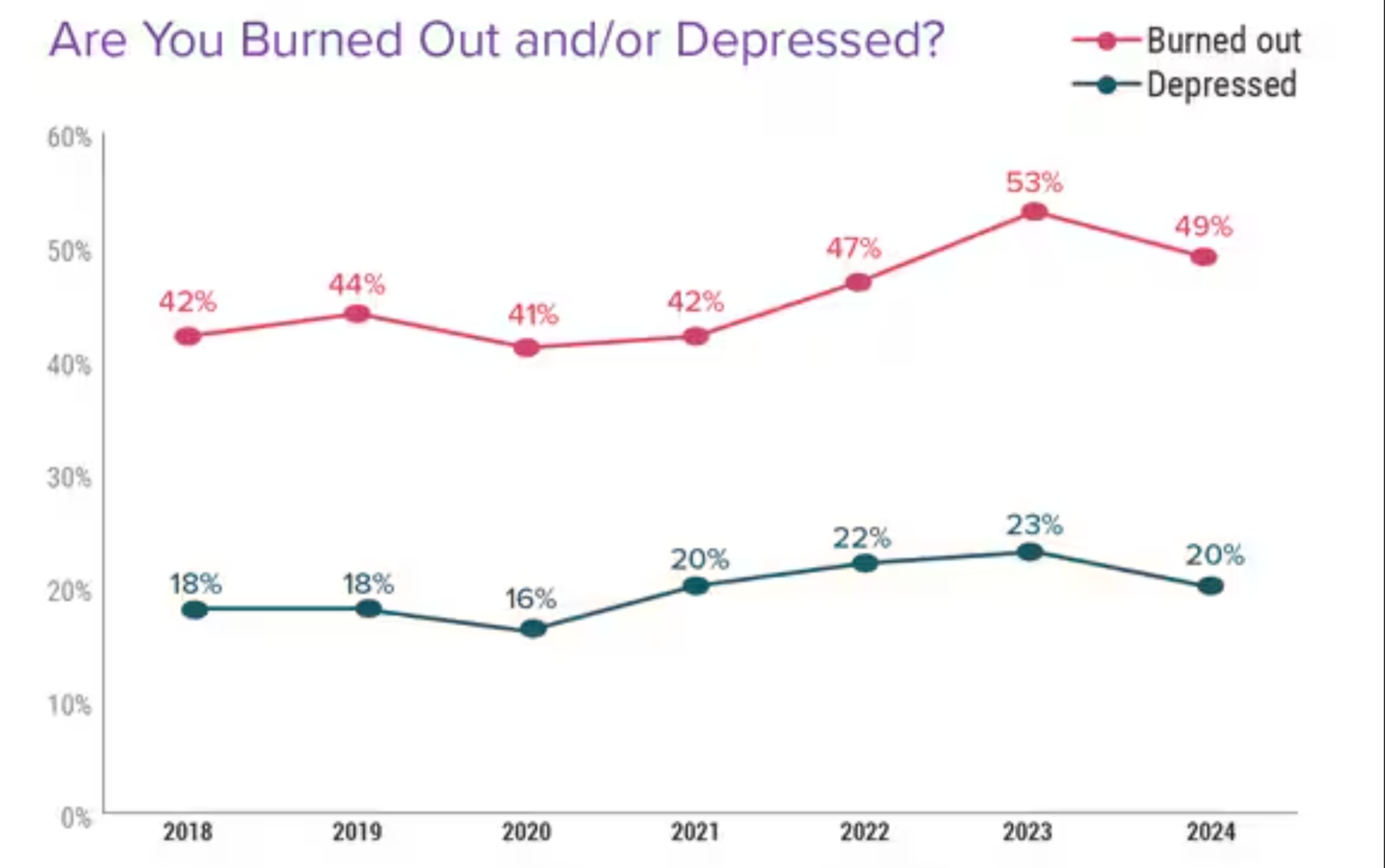
Source: American Medical Association — National Physician Burnout Report (2024).
One final question summarized everything:
What would it take for you to thrive, and not just survive, at work?
Here is what they said:
Stronger leadership and leading by example
Personal confidence
Time-management skills
Communication skills
Leadership and people-management training
Input into the interviewing and hiring process
More structured teaching
Team building
Work/life-balance skills (strong emphasis)
More daytime ward support
Recognition of performance and/or outcomes
Why These Questions Matter
Resident surgeons often behave exactly as the surgeons who trained them — inheriting outdated behaviours, scarcity mindsets, and fear-based tactics that may have worked decades ago but no longer fit today’s culture, legislation, ethics, or expectations.
However, here’s where the situation becomes complex:
Surgeons — and surgeons in training — are not employees.They are business owners or future business owners.
After 16+ years of medical school, residency, fellowship, and a late entry into the workforce, many surgeons hit the ground running with:
Massive debt
High tax brackets
Immense pressure to perform
Limited leadership experience
Major responsibilities
Minimal training in people-and-culture systems
Combine all of this, and you have the perfect storm for relationship breakdowns, workplace conflict, burnout, and emotional exhaustion.
So who is the watchdog over all the complex, and mixed-up dynamics — surgeon-owners face? Without intervention, the answer is: no one. They are simply doing the best they can.
A Way Forward
Healthcare is complex, but transformation always begins with leadership. Not leadership by title, but leadership by training, character, and culture.
Residents, Surgeons and Patients will all benefit from leaders who influence their teams positively.
This is where my work begins.
On the other side of the chaos is clarity, structure, and hope.
And the pathway to that transformation begins with learning how to lead your practice, not just let it run you. If you would like more information about the MOA Hiring and HR Mastery 101 minute course by Dr. Tim Riegel, FRCSC & Nancy Riegel, Executive Coach & Author, who will help you take back control of your office, please connect here:
This course was created for surgeons, residents, and clinic leaders who want to strengthen their teams, elevate their workplace culture, and build practices grounded in excellence—not chaos. Inside, you’ll learn the people-and-culture strategies that transform burnout into stability, disorder into structure, and overwhelm into leadership confidence.
About the Authors of MOA Hiring and HR Mastery 101 minute Course
Dr. Tim Riegel, FRCSC
Burn, Plastics & Reconstructive Surgeon
Led surgical teams across multiple provinces, with 30+ years of combined education and practice.
Nancy Riegel
Executive Coach | Author | Harvard Healthcare Economics
Specializing in leadership, people-and-culture systems, with 30 years of organizational development experience—including work with a Fortune 500 company.
We welcome any comments to this blog. We would love to see you at our You Tube channel here.
Please contact Nancy Riegel if you would like to implement a survey within your surgical group.